Carpenter ants do not consume wood; they excavate galleries within timber softened by chronic dampness to expand satellite nesting sites. In the Cathedral Historic District and All Saints, historic structural framing…
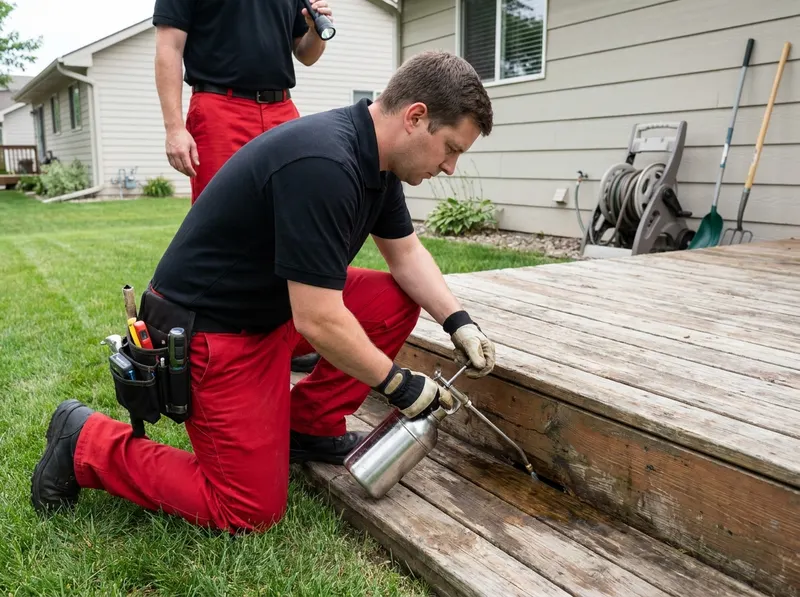
Carpenter ants do not consume wood; they excavate galleries within timber softened by chronic dampness to expand satellite nesting sites. In the Cathedral Historic District and All Saints, historic structural framing frequently develops concealed plumbing condensation behind plaster or roof-line seepage near box gutters, providing ideal nesting conditions. In newer construction throughout Prairie Tree, Spader, and Harmodon, landscape irrigation striking window casements or exterior sill plates near ground level creates the damp wood fibers Camponotus colonies require. Eradication fails when homeowners apply grocery-store pyrethroid sprays to surface trails, as repellent surface chemicals cause stressed worker ants to fracture into multiple secondary satellite colonies inside drywall cavities.
Effective management requires addressing the underlying damp timber alongside targeted void eradication. Technicians identify moisture gradients exceeding 18% inside wall studs using pinless meters, pinpointing exact nest cavities without destructive demolition. Non-repellent active ingredients are injected directly into localized wall voids rather than sprayed indiscriminately across living room baseboards, preventing airborne chemical exposure around children and pets while allowing foragers to carry the undetectable chemistry back to the parent queen. Ground-level exclusion seals exterior foundation gaps along rim joists and siding transitions, preventing exterior foragers from the Big Sioux River corridor or river bottomlands near Riverview and Tuthill from bridging into residential frameworks.
Decision-fit guidance depends on the maturity of the colony and visible evidence. If property owners observe coarse, wood-colored frass mixed with insect parts beneath window aprons or hear faint crinkling sounds inside drywall, structural void treatment is necessary. If only isolated black ants appear outdoors on driveway concrete without indoor frass, basic exterior perimeter trimming and sealing suffice. The operational trade-off of targeted structural ant remediation involves repairing the underlying building envelope: eradicating the biological colony removes the immediate excavation hazard, but long-term structural integrity requires remediating the active plumbing, roof, or drainage defect to keep replacement queens from colonizing the damp wood fiber in future seasons.
Every job gets a firm, written price after a free on-site visit.
Tell us about your moisture-associated carpenter ant control job in Sioux Falls and we'll send a clear, written quote, usually the same day.
 Solvian Bug Removal